




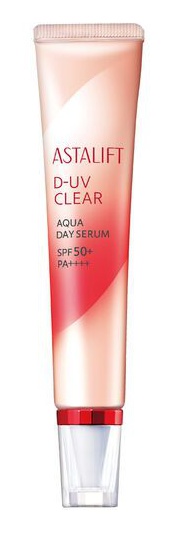
D-UV Clear Aqua Day Serum SPF50+ Pa++++
Ingredients overview
Highlights
Key Ingredients
Other Ingredients
Skim through
ASTALIFT D-UV Clear Aqua Day Serum SPF50+ Pa++++Ingredients explained
Good old water, aka H2O. The most common skincare ingredient of all. You can usually find it right in the very first spot of the ingredient list, meaning it’s the biggest thing out of all the stuff that makes up the product.
It’s mainly a solvent for ingredients that do not like to dissolve in oils but rather in water.
Once inside the skin, it hydrates, but not from the outside - putting pure water on the skin (hello long baths!) is drying.
One more thing: the water used in cosmetics is purified and deionized (it means that almost all of the mineral ions inside it is removed). Like this, the products can stay more stable over time.
A clear, oil-soluble, "cosmetically-elegant" liquid that is the most commonly used chemical sunscreen. It absorbs UVB radiation (at wavelengths: 280-320 nm) with a peak protection at 310nm.
It only protects against UVB and not UVA rays (the 320-400 nm range) – so always choose products that contain other sunscreens too. It is not very stable either, when exposed to sunlight, it kind of breaks down and loses its effectiveness (not instantly, but over time - it loses 10% of its SPF protection ability within 35 mins). To make it more stable it can be - and should be - combined with other sunscreen agents to give stable and broad-spectrum protection (the new generation sunscreen agent, Tinosorb S is a particularly good one for that).
Regarding safety, there are also some concerns around Octinoxate. In vitro (made in the lab not on real people) and animal studies have shown that it may produce hormonal (estrogen-like) effects. Do not panic, the studies were not conducted under real life conditions on real human people, so it is probably over-cautious to avoid Octinoxate altogether. However, if you are pregnant or a small child (under 2 yrs. old), choose a physical (zinc oxide/titanium dioxide) or new-generation Tinosorb based sunscreen, just to be on the super-safe side. :)
Overall, Ethylhexyl Methoxycinnamate is an old-school chemical sunscreen agent. There are plenty of better options for sun protection today, but it is considered "safe as used" (and sunscreens are pretty well regulated) and it is available worldwide (can be used up to 10% in the EU and up to 7.5% in the US).
Diethylamino Hydroxybenzoyl Hexyl Benzoate is a new generation, chemical sunscreen agent (not available in the US due to impossible FDA regulations) that's designed for high UVA protection and high photostability. It gives sun protection in the whole UVA range (320-400 nm) with peak protection at 354nm. It can be used up to 10% worldwide except for the US and Canada.
An emollient ester with a rich and creamy but non-greasy skin feel. It makes skin supple and protects dry skin.
Simply alcohol refers to ethanol and it's a pretty controversial ingredient. It has many instant benefits: it's a great solvent, penetration enhancer, creates cosmetically elegant, light formulas, great astringent and antimicrobial. No wonder it's popular in toners and oily skin formulas.
The downside is that it can be very drying if it's in the first few ingredients on an ingredient list.
Some experts even think that regular exposure to alcohol damages skin barrier and causes inflammation though it's a debated opinion. If you wanna know more, we wrote a more detailed explanation about what's the deal with alcohol in skincare products at alcohol denat. (it's also alcohol, but with some additives to make sure no one drinks it).
Its INCI name is a bit of a mouthful, but Bis-Ethylhexyloxyphenol Methoxyphenyl Triazine is worth recognizing it as it is one of the best sunscreen agents known today. Unfortunately, it's not FDA-approved so you will not find it in sunscreens coming from the US (not because it's not good, but because US regulations make it impossible for newer sunscreen agents to get approved), but it is widely available in other parts of the world like Europe, Australia or Asia.
It is a broad-spectrum (covers the whole UVB and UVA range, 280-400 nm) chemical sunscreen agent with peak protections at about 310 and 345 nm and unlike older UV filters, it's very photostable. It hardly deteriorates in the presence of UV light and it's also useful in stabilizing other less stable sunscreen agents, like the famous UVA protector, avobenzone.
It's a new generation sunscreen agent that was specifically designed for high SPF and good UVA protection and based on a 2007 study that compared 18 sunscreen agents available in the EU it really had the best SPF protection (they used the highest concentration allowed by EU regulations from each 18 sunscreens and Trinosorb S gave an SPF 20 all by itself).
It is an oil-soluble, slightly yellowish powder that is not absorbed into the skin too much. This is good news for a sunscreen agent as it needs to be on the surface of the skin to do its job properly. Regarding Bis-Ethylhexyloxyphenol Methoxyphenyl Triazine side effects, we have good news here as well: it has a great safety profile and unlike a couple of other chemical sunscreens, Trinosorb S (and M) does not show estrogenic activity.
Overall, we think Trinosorb S is one of the best sunscreen options available today.
Are you into sunscreen agents? We have shiny explanations (along with product lists) about others as well:
- Methylene Bis-Benzotriazolyl Tetramethylbutylphenol, aka Tinosorb M, the good buddy of our current molecule Tinosorb S
- Tris-Biphenyl Triazine, aka Tinosorb A2B, the newest addition to the Tinosorb family that protects strongly in an in-between wavelength that most other filters miss
- Ethylhexyl Triazone, aka Uvinul T 150, another new generation sunscreen agent with super-high UVB protection
- Diethylamino Hydroxybenzoyl Hexyl Benzoate, aka Uvinul A Plus, a new generation sunscreen for UVA protection
Ethylhexyl Triazone is a new generation, chemical sunscreen (not available in the US due to impossible FDA regulations) that gives the highest photo-stable absorption of all available UVB filters today. It protects in the UVB range (280-320nm) with a peak protection of 314nm. It is an oil soluble, odorless, colorless powder that works well in fragrance-free formulas. It can be used up to 5% worldwide except for the US and Canada.
A 100% vegetable origin emulsifier that usually comes to the formula with its buddy called C12-20 Alkyl Glucoside. The duo is trade-named Montanov L and works as an effective oil in water emulsifier. It creates ultra-soft, light texture, has excellent dermo-compatibility and is readily biodegradable.
Chemically speaking, it is a mixture of fatty alcohols with 14 to 22 carbon atoms in their fatty chains.
Probably the most common silicone of all. It is a polymer (created from repeating subunits) molecule and has different molecular weight and thus different viscosity versions from water-light to thick liquid.
As for skincare, it makes the skin silky smooth, creates a subtle gloss and forms a protective barrier (aka occlusive). Also, works well to fill in fine lines and wrinkles and give skin a plump look (of course that is only temporary, but still, it's nice). There are also scar treatment gels out there using dimethicone as their base ingredient. It helps to soften scars and increase their elasticity.
As for hair care, it is a non-volatile silicone meaning that it stays on the hair rather than evaporates from it and smoothes the hair like no other thing. Depending on your hair type, it can be a bit difficult to wash out and might cause some build-up (btw, this is not true to all silicones, only the non-volatile types).
 We don't have description for this ingredient yet.
- Primary fat-soluble antioxidant in our skin
- Significant photoprotection against UVB rays
- Vit C + Vit E work in synergy and provide great photoprotection
- Has emollient properties
- Easy to formulate, stable and relatively inexpensive
The long name covers a nice sunscreen agent and quite a special one at that: It's a "hybrid" sunscreen meaning it's half-way between physical (the ones that, at least partly, reflect the sun) and chemical agents (that absorb the rays, which most sunscreens do). It is a new generation UV filter and, just like its sister, Trinosorb S, it is not available in the US.
It gives nice broad-spectrum coverage (280-400 nm, meaning UVB as well as UVA protecion) with peak protection at 305 nm and 360 nm and it is highly photostable. It can also help to stabilize other less stable sunscreens, like Octinoxate and is generally happy to work together with other UV-filters.
Its hybrid nature means that it is organic like the chemical agents, but it is neither water nor oil soluble and works as a suspension of micro fine particles. If the small particles scare you, we have good news: the safety profile of Tinosorb M is great. It is not absorbed into the skin and unlike some other chemical sunscreens, it does not show estrogenic activity.
The downside of its hybrid nature is that - similar to the inorganic sunscreens zinc and titanium dioxide - Tinosorb M also leaves a white cast on the skin that can be bothersome on darker skin tones.
A clear, colorless, practically odorless, light liquid that works as a handy helper ingredient in sunscreen formulas. It helps to create high-SPF formulas with reduced concentrations of UV-filters and it also helps to create cosmetically elegant formulas (and that's no easy feat when it comes to sunscreens). It absorbs rapidly, makes the product easily spreadable and reduces greasiness coming from the oil-soluble sunscreen agents.
- A natural moisturizer that’s also in our skin
- A super common, safe, effective and cheap molecule used for more than 50 years
- Not only a simple moisturizer but knows much more: keeps the skin lipids between our skin cells in a healthy (liquid crystal) state, protects against irritation, helps to restore barrier
- Effective from as low as 3% with even more benefits for dry skin at higher concentrations up to 20-40%
- High-glycerin moisturizers are awesome for treating severely dry skin
A super commonly used 5 unit long, cyclic structured silicone that is water-thin and does not stay on the skin but evaporates from it (called volatile silicone). Similar to other silicones, it gives skin and hair a silky, smooth feel.
It's often combined with the non-volatile (i.e. stays on the skin) dimethicone as the two together form a water-resistant, breathable protective barrier on the skin without a negative tacky feel.
It’s pretty much the current IT-preservative. It’s safe and gentle, but even more importantly, it’s not a feared-by-everyone-mostly-without-scientific-reason paraben.
It’s not something new: it was introduced around 1950 and today it can be used up to 1% worldwide. It can be found in nature - in green tea - but the version used in cosmetics is synthetic.
Other than having a good safety profile and being quite gentle to the skin it has some other advantages too. It can be used in many types of formulations as it has great thermal stability (can be heated up to 85°C) and works on a wide range of pH levels (ph 3-10).
It’s often used together with ethylhexylglycerin as it nicely improves the preservative activity of phenoxyethanol.
A 100% vegetable origin emulsifier that usually comes to the formula with its buddy called C14-22 Alcohols. The duo is called Montanov L and two together help to create ultra-soft light formulas.
A kind of polymer (big molecule from repeated subunits) that helps to create beautiful gel-like textures. It's also a texturizer and thickener for oil-in-water emulsions. It gives products a good skin feel and does not make the formula tacky or sticky.
It works over a wide pH range and is used between 0.5-1.2%.
A polymeric (big molecule from repeated subunits) emulsifier that comes from Inulin, a naturally occurring polysaccharide found in the roots and rhizomes of several plants. The emulsifier is obtained by adding oil-loving chains onto inulin. The resulting copolymer can emulsify high amounts of oil and can stabilize oil droplets or non-water soluble particles so that they do not clump together in the formula.
We don't have description for this ingredient yet.
Titanium Dioxide is one of the two members of the elite sunscreen group called physical sunscreens (or inorganic sunscreens if you’re a science geek and want to be precise).
Traditionally, UV-filters are categorized as either chemical or physical. The big difference is supposed to be that chemical agents absorb UV-light while physical agents reflect it like a bunch of mini umbrellas on top of the skin. While this categorization is easy and logical it turns out it's not true. A recent, 2016 study shows that inorganic sunscreens work mostly by absorption, just like chemical filters, and only a little bit by reflection (they do reflect the light in the visible spectrum, but mostly absorb in the UV spectrum).
Anyway, it doesn't matter if it reflects or absorbs, Titanium Dioxide is a pretty awesome sunscreen agent for two main reasons: it gives a nice broad spectrum coverage and it's highly stable. Its protection is very good between 290 - 350 nm (UVB and UVA II range), and less good at 350-400 nm (UVA I) range. Regular sized Titanium Dioxide also has a great safety profile, it's non-irritating and is pretty much free from any health concerns (like estrogenic effect worries with some chemical filters).
The disadvantage of Titanium Dioxide is that it's not cosmetically elegant, meaning it's a white, "unspreadable" mess. Sunscreens containing Titanium Dioxide are often hard to spread on the skin and they leave a disturbing whitish tint. The cosmetic industry is, of course, really trying to solve this problem and the best solution so far is using nanoparticles. The itsy-bitsy Nano-sized particles improve both spreadability and reduce the whitish tint a lot, but unfortunately, it also introduces new health concerns.
The main concern with nanoparticles is that they are so tiny that they are absorbed into the skin more than we want them (ideally sunscreen should remain on the surface of the skin). Once absorbed they might form unwanted complexes with proteins and they might promote the formation of evil free radicals. But do not panic, these are concerns under investigation. A 2009 review article about the safety of nanoparticles summarizes this, "to date, in-vivo and in-vitro studies have not demonstrated percutaneous penetration of nanosized particles in titanium dioxide and zinc oxide sunscreens". The English translation is, so far it looks like sunscreens with nanoparticles do stay on the surface of the skin where they should be.
All in all, Titanium Dioxide is a famous sunscreen agent and for good reason, it gives broad spectrum UV protection (best at UVB and UVA II), it's highly stable, and it has a good safety profile. It's definitely one of the best UV-filter agents we have today, especially in the US where new-generation Tinosorb filters are not (yet) approved.
A big molecule created from repeated subunits (a polymer of acrylic acid) that magically converts a liquid into a nice gel formula. It usually has to be neutralized with a base (such as sodium hydroxide) for the thickening to occur and it creates viscous, clear gels that also feel nice and non-tacky on the skin. No wonder, it is a very popular and common ingredient. Typically used at 1% or less in most formulations.
A vegetable origin (coconut or palm kernel oil and glucose) cleansing agent with great foaming abilities. It's also mild to the skin and readily biodegradable.
The salt form of one of the main anti-inflammatory ingredients in the licorice plant, monoammonium glycyrrhizinate. It’s a yellowish powder with a nice sweet smell.
It’s used mainly for its soothing and anti-inflammatory properties, but according to manufacturer info, it’s also sebum regulating so it's a perfect ingredient for problem skin products.
Read more about licorice and why it's a skincare superstar here.
A silicone emulsifier that helps water to mix nicely with silicone oils (aka water-in-silicone emulsifier).
If you have spotted ethylhexylglycerin on the ingredient list, most probably you will see there also the current IT-preservative, phenoxyethanol. They are good friends because ethylhexylglycerin can boost the effectiveness of phenoxyethanol (and other preservatives) and as an added bonus it feels nice on the skin too.
Also, it's an effective deodorant and a medium spreading emollient.
Exactly what it sounds: nice smelling stuff put into cosmetic products so that the end product also smells nice. Fragrance in the US and parfum in the EU is a generic term on the ingredient list that is made up of 30 to 50 chemicals on average (but it can have as much as 200 components!).
If you are someone who likes to know what you put on your face then fragrance is not your best friend - there's no way to know what’s really in it.
Also, if your skin is sensitive, fragrance is again not your best friend. It’s the number one cause of contact allergy to cosmetics. It’s definitely a smart thing to avoid with sensitive skin (and fragrance of any type - natural is just as allergic as synthetic, if not worse!).
The famous Avobenzone. It is a special snowflake as it is the only globally available chemical sunscreen agent that provides proper UVA protection (in the US, new generation sunscreen agents are not approved because of impossible FDA regulations). It is the global gold standard of UVA protection and is the most used UVA sunscreen in the world.
It gives very good protection across the whole UVA range (310-400 nm that is both UVA1 and UVA2) with a peak protection at 360 nm. The problem with it, though, is that it is not photostable and degrades in the sunlight. Wikipedia says that avobenzone loses 36% of its UV-absorption capacity after just one hour of sunlight (yep, this is one of the reasons why sunscreens have to be reapplied after a few hours).
The cosmetic's industry is trying to solve the problem by combining avobenzone with other UV filters that enhance its stability (like octocrylene, Tinosorb S or Ensulizole) or by encapsulating it and while both solutions help, neither is perfect. Interestingly, the combination of avobenzone with mineral sunscreens (that is titanium dioxide and zinc oxide) is not a good idea. In the US, it is flat out prohibited as avobenzone becomes unstable when combined with mineral sunscreens.
As for safety, avobenzone has a pretty good safety profile. It counts as non-irritating, and unlike some other chemical sunscreens, it shows no estrogenic effect. The maximum concentration of avobenzone permitted is 5% in the EU and 3% in the US.
Officially, CosIng (the official EU ingredient database) lists Aluminum Hydroxide 's functions as opacifying (making the product white and non-transparent), as well as emollient and skin protectant.
However, with a little bit of digging, it turns out Aluminum Hyroxide often moonlights as a protective coating for UV filter superstar Titanium Dioxide. Specifically, it protects our skin from the harmful effects of nasty Reactive Oxygen Species (free radicals derived from oxygen such as Superoxide and Hydrogen Peroxide) generated when Titanium Dioxide is exposed to UV light. Btw, chlorine in swimming pool water depletes this protective coating, so one more reason to reapply your sunscreen after a dip in the pool on holiday.
Other than that, Aluminum Hydroxide also often shows up in composite pigment technologies where it is used the other way around (as the base material and not as the coating material) and helps to achieve higher color coverage with less pigment.
A liquid fatty acid created from oleic acid. It's claimed to have great odour, thermal and oxidation stability and is great for the stabilization of pigments and mineral particles in oils and solvents. It's quite popular in foundations.
Butylene glycol, or let’s just call it BG, is a multi-tasking colorless, syrupy liquid. It’s a great pick for creating a nice feeling product.
BG’s main job is usually to be a solvent for the other ingredients. Other tasks include helping the product to absorb faster and deeper into the skin (penetration enhancer), making the product spread nicely over the skin (slip agent), and attracting water (humectant) into the skin.
It’s an ingredient whose safety hasn’t been questioned so far by anyone (at least not that we know about). BG is approved by Ecocert and is also used enthusiastically in natural products. BTW, it’s also a food additive.
The unfancy name for it is lye. It’s a solid white stuff that’s very alkaline and used in small amounts to adjust the pH of the product and make it just right.
For example, in case of AHA or BHA exfoliants, the right pH is super-duper important, and pH adjusters like sodium hydroxide are needed.
BTW, lye is not something new. It was already used by ancient Egyptians to help oil and fat magically turn into something else. Can you guess what? Yes, it’s soap. It still often shows up in the ingredient list of soaps and other cleansers.
Sodium hydroxide in itself is a potent skin irritant, but once it's reacted (as it is usually in skin care products, like exfoliants) it is totally harmless.
Super common little helper ingredient that helps products to remain nice and stable for a longer time. It does so by neutralizing the metal ions in the formula (that usually get into there from water) that would otherwise cause some not so nice changes.
It is typically used in tiny amounts, around 0.1% or less.
- It's a helper ingredient that improves the freeze-thaw stability of products
- It's also a solvent, humectant and to some extent a penetration enhancer
- It has a bad reputation among natural cosmetics advocates but cosmetic scientists and toxicology experts do not agree (read more in the geeky details section)
It's one of the most commonly used thickeners and emulsion stabilizers. If the product is too runny, a little xanthan gum will make it more gel-like. Used alone, it can make the formula sticky and it is a good team player so it is usually combined with other thickeners and so-called rheology modifiers (helper ingredients that adjust the flow and thus the feel of the formula). The typical use level of Xantha Gum is below 1%, it is usually in the 0.1-0.5% range.
Btw, Xanthan gum is all natural, a chain of sugar molecules (polysaccharide) produced from individual sugar molecules (glucose and sucrose) via fermentation. It’s approved by Ecocert and also used in the food industry (E415).
We don't have description for this ingredient yet.
We are big fans of all kinds of roses as ornamental plants but when it comes to skincare, it is a mixed bag. Before we list out the good and the not so good, here is an interesting thing.
The oil content in rose is very, very low so distilling rose essential oil requires huge amounts of rose flowers. It has such a wonderful scent that there are no comparable synthetic alternatives. You can probably guess that this means rose essential oil is expensive.... very very expensive.
So the good things: thanks to its wonderful scent the high-end perfume industry loves rose oil. Also, we (humans :)) love rose oil. We love its scent so much that it can heal headaches, depression, stress, and even grief.
Rose oil contains more than 95 compounds, among them flavonoids, anthocyanins, vitamin C, and quercetin that are all known for their medicinal properties and great antioxidant effects. Similar to many other essential oils, it has antimicrobial properties too.
Now, the not-so-good thing? Out of the 95 compounds, the major ones are citronellol and geraniol, fragrant components that might irritate sensitive skin.
We don't have description for this ingredient yet.
We don't have description for this ingredient yet.
A super versatile and common mineral powder that comes in different particle sizes. It is a multi-tasker used to improve skin feel, increase product slip, give the product light-reflecting properties, enhance skin adhesion or serve as an anti-caking agent.
It is also the most commonly used "base" material for layered composite pigments such as pearl-effect pigments. In this case, mica is coated with one or more metal oxides (most commonly titanium dioxide) to achieve pearl effect via the physical phenomenon known as interference.
A super common emollient that makes your skin feel nice and smooth. It comes from coconut oil and glycerin, it’s light-textured, clear, odorless and non-greasy. It’s a nice ingredient that just feels good on the skin, is super well tolerated by every skin type and easy to formulate with. No wonder it’s popular.
We don't have description for this ingredient yet.
A sugar ester (sucrose + stearic acid) that works as a natural emulsifier (helps water and oil to mix). It's popular in oily gel cleansers as it improves the high-temperature stability of the formula.
Soluble Collagen refers to the big, natural collagen molecules mostly extracted from fish or bovine skin. Spotting collagen on the ingredient list, you might think that, aha, this must be there to supplement the collagen content of our own skin, but you have to know that collagen is a huge-huge molecule that cannot absorb to the middle layer of the skin where collagen is and even if it could, it cannot just magically go the right places to become part of the skin's own collagen network. Putting collagen on your skin for anti-aging purposes is like throwing tent poles onto a ramshackle tent and expecting the tent to magically become nice and firm again.
The strong point of collagen is being a large molecule with tremendous water binding capacity, i.e. an amazing humectant and moisturizer. It produces a water-rich film on the skin giving the stratum corneum (the uppermost layer of the skin) great hydration, making it nice and smooth and reducing trans-epidermal-water loss (the process of water evaporating out of your skin).
It is also so gentle and non-irritant that it can actually be used in cleansers to reduce the irritating potential of harsh surfactants, aka cleansing agents.
If you are fine with animal-derived ingredients and know that collagen in a jar has nothing to do with wrinkles but everything to do with skin hydration, Soluble Collagen is a nice ingredient.
A so-called exopolysaccharide (high-molecular-weight polymers) secreted by a microorganism living in hydrothermal deep vents. The manufacturer claims that it soothes and reduces irritation to sensitive skin against chemical (such as drying acne treatments or strong chemical exfoliants), mechanical (such as micro-cuts after shaving) and UVB aggressors.
A very common ingredient that can be found in all cell membranes. In cosmetics it's quite the multi-tasker: it's an emollient and water-binding ingredient but it's also an emulsifier and can be used for stabilization purposes. It's also often used to create liposomes.
The chemically chopped up version of the big protein molecule, collagen. It is often derived from fish or bovine sources and works as a nice moisturizer and humectant that helps the skin to hold onto water.
To understand a bit more what Hydrolyzed Collagen is, you have to know that proteins are large chains of amino acids connected with so-called peptide bonds. These bonds can be broken up when a water molecule is added and the resulting thing is a mix of shorter length amino acids, also called peptides. So Hydrolyzed Collagen is not really collagen, it is rather an undefined and varying mix of largish peptides. Based on a manufacturer's data, the whole, soluble collagen has an average molecular weight of 300 000 Da, while this chopped up mixture has an average MW of 12 000 Da (still pretty big).
The main thing of these largish peptides is to act as water-binding agents, and to make the skin nice and smooth (aka emollient). Hydrolyzed Collagen is also often used in cleansers as it can make harsh surfactants milder and in hair conditioners as it improves the flexibility and manageability of hair.
If you wanna know more about collagen in cosmetics, we have a shiny explanation about soluble collagen here >>
A traditional Chinese herbal medicine loaded with potent antioxidant and anti-inflammatory flavonoids such as baicalin, baicalein, and wogonin.
If that would not be enough, Skullcap Root is also claimed to have antimicrobial and antifungal properties (also against P.acnes and Malassezia furfur) as well as some skin-brightening activity. A multi-functional skin-goodie.
We don't have description for this ingredient yet.
We don't have description for this ingredient yet.
You may also want to take a look at...
| what‑it‑does | solvent |
| what‑it‑does | sunscreen |
| irritancy, com. | 0, 0 |
| what‑it‑does | sunscreen |
| what‑it‑does | emollient |
| what‑it‑does | antimicrobial/antibacterial | solvent | viscosity controlling |
| what‑it‑does | sunscreen |
| what‑it‑does | sunscreen |
| what‑it‑does | emollient |
| irritancy, com. | 0, 1 |
| what‑it‑does | antioxidant |
| irritancy, com. | 0-3, 0-3 |
| what‑it‑does | sunscreen |
| what‑it‑does | emollient | solvent |
| what‑it‑does | skin-identical ingredient | moisturizer/humectant |
| irritancy, com. | 0, 0 |
| what‑it‑does | emollient | solvent |
| what‑it‑does | preservative |
| what‑it‑does | emulsifying | surfactant/cleansing |
| what‑it‑does | viscosity controlling |
| what‑it‑does | surfactant/cleansing | emulsifying |
| what‑it‑does | moisturizer/humectant | solvent |
| what‑it‑does | sunscreen | colorant |
| what‑it‑does | viscosity controlling |
| irritancy, com. | 0, 1 |
| what‑it‑does | surfactant/cleansing |
| what‑it‑does | soothing | moisturizer/humectant |
| what‑it‑does | emulsifying |
| what‑it‑does | preservative |
| what‑it‑does | perfuming |
| what‑it‑does | sunscreen |
| what‑it‑does | emollient | moisturizer/humectant | viscosity controlling |
| what‑it‑does | surfactant/cleansing | emulsifying |
| what‑it‑does | moisturizer/humectant | solvent |
| irritancy, com. | 0, 1 |
| what‑it‑does | buffering |
| what‑it‑does | chelating |
| what‑it‑does | moisturizer/humectant | solvent |
| irritancy, com. | 0, 0 |
| what‑it‑does | viscosity controlling |
| what‑it‑does | antioxidant |
| what‑it‑does | antioxidant | perfuming | antimicrobial/antibacterial |
| what‑it‑does | emollient | moisturizer/humectant |
| what‑it‑does | moisturizer/humectant |
| what‑it‑does | colorant |
| what‑it‑does | emollient |
| what‑it‑does | emollient |
| what‑it‑does | emollient | emulsifying | surfactant/cleansing |
| irritancy, com. | 0, 0 |
| what‑it‑does | moisturizer/humectant |
| what‑it‑does | soothing |
| what‑it‑does | emollient | emulsifying |
| what‑it‑does | emollient | moisturizer/humectant |
| what‑it‑does | soothing | antioxidant | antimicrobial/antibacterial | moisturizer/humectant |
| what‑it‑does | emulsifying |
| what‑it‑does | antioxidant |