




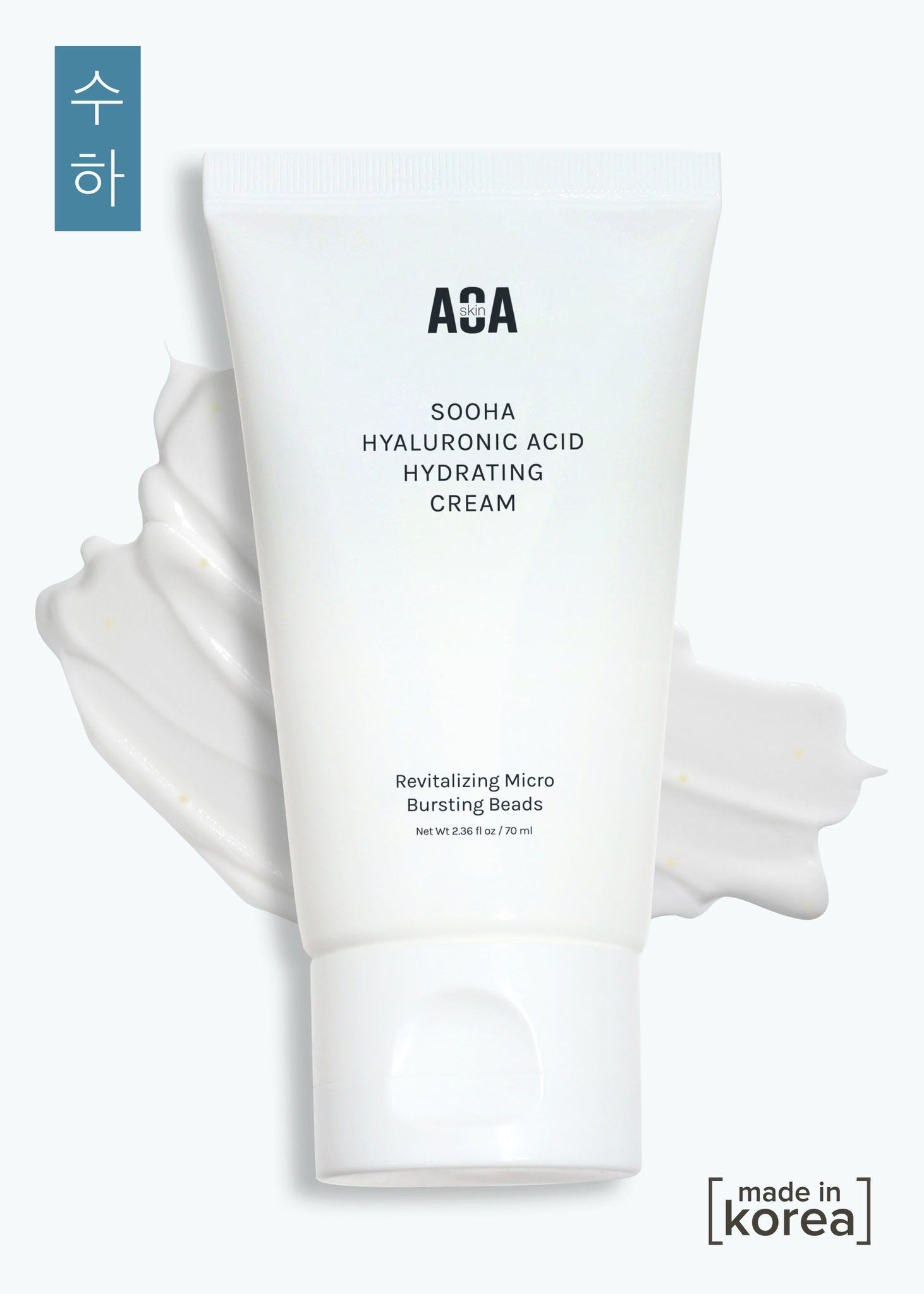
Sooha Hyaluronic Acid Hydrating Cream
Ingredients overview
Highlights
Key Ingredients
Skim through
AOA Skin Sooha Hyaluronic Acid Hydrating CreamIngredients explained
Good old water, aka H2O. The most common skincare ingredient of all. You can usually find it right in the very first spot of the ingredient list, meaning it’s the biggest thing out of all the stuff that makes up the product.
It’s mainly a solvent for ingredients that do not like to dissolve in oils but rather in water.
Once inside the skin, it hydrates, but not from the outside - putting pure water on the skin (hello long baths!) is drying.
One more thing: the water used in cosmetics is purified and deionized (it means that almost all of the mineral ions inside it is removed). Like this, the products can stay more stable over time.
Butylene glycol, or let’s just call it BG, is a multi-tasking colorless, syrupy liquid. It’s a great pick for creating a nice feeling product.
BG’s main job is usually to be a solvent for the other ingredients. Other tasks include helping the product to absorb faster and deeper into the skin (penetration enhancer), making the product spread nicely over the skin (slip agent), and attracting water (humectant) into the skin.
It’s an ingredient whose safety hasn’t been questioned so far by anyone (at least not that we know about). BG is approved by Ecocert and is also used enthusiastically in natural products. BTW, it’s also a food additive.
- A natural moisturizer that’s also in our skin
- A super common, safe, effective and cheap molecule used for more than 50 years
- Not only a simple moisturizer but knows much more: keeps the skin lipids between our skin cells in a healthy (liquid crystal) state, protects against irritation, helps to restore barrier
- Effective from as low as 3% with even more benefits for dry skin at higher concentrations up to 20-40%
- High-glycerin moisturizers are awesome for treating severely dry skin
A super common emollient that makes your skin feel nice and smooth. It comes from coconut oil and glycerin, it’s light-textured, clear, odorless and non-greasy. It’s a nice ingredient that just feels good on the skin, is super well tolerated by every skin type and easy to formulate with. No wonder it’s popular.
A really multi-functional helper ingredient that can do several things in a skincare product: it can bring a soft and pleasant feel to the formula, it can act as a humectant and emollient, it can be a solvent for some other ingredients (for example it can help to stabilize perfumes in watery products) and it can also help to disperse pigments more evenly in makeup products. And that is still not all: it can also boost the antimicrobial activity of preservatives.
- A multi-functional skincare superstar with several proven benefits for the skin
- Great anti-aging, wrinkle smoothing ingredient used at 4-5% concentration
- Fades brown spots alone or in combination with amino sugar, acetyl glucosamine
- Increases ceramide synthesis that results in a stronger, healthier skin barrier and better skin hydration
- Can help to improve several skin conditions including acne, rosacea, and atopic dermatitis
You probably know olive oil from the kitchen as a great and healthy option for salad dressing but it's also a great and healthy option to moisturize and nourish the skin, especially if it's on the dry side.
Similar to other emollient plant oils, it's loaded with nourishing fatty acids: oleic is the main component (55-83%), and also contains linoleic (3.5-20%) and palmitic acids (7-20%). It also contains antioxidant polyphenols, tocopherols (types of vitamin E) and carotenoids and it's one of the best plant sources of skin-identical emollient, Squalene.
Overall, a great option for dry skin but less so for acne-prone or damaged skin.
It’s a handy multi-tasking ingredient that gives the skin a nice, soft feel. At the same time, it also boosts the effectiveness of other preservatives, such as the nowadays super commonly used phenoxyethanol.
The blend of these two (caprylyl glycol + phenoxyethanol) is called Optiphen, which not only helps to keep your cosmetics free from nasty things for a long time but also gives a good feel to the finished product. It's a popular duo.
It's a little helper ingredient that helps to set the pH of the products to be right. It has an alkaline pH and can neutralize acidic ingredients.
A 100% vegetable origin emulsifier that usually comes to the formula with its buddy called C12-20 Alkyl Glucoside. The duo is trade-named Montanov L and works as an effective oil in water emulsifier. It creates ultra-soft, light texture, has excellent dermo-compatibility and is readily biodegradable.
Chemically speaking, it is a mixture of fatty alcohols with 14 to 22 carbon atoms in their fatty chains.
This long-named, polymer molecule (big molecule from repeated subunits) is a helper ingredient that's good at emulsifying and stabilizing oils into water-based formulas. It also acts as a thickening and gelling agent that creates nice, non-sticky and supple textures. It works over a very wide pH range (3-12) and can be used to thicken up low-ph formulas, such as exfoliants. Its recommended used range is 0.3-3%.
A big molecule created from repeated subunits (a polymer of acrylic acid) that magically converts a liquid into a nice gel formula. It usually has to be neutralized with a base (such as sodium hydroxide) for the thickening to occur and it creates viscous, clear gels that also feel nice and non-tacky on the skin. No wonder, it is a very popular and common ingredient. Typically used at 1% or less in most formulations.
An extremely common multitasker ingredient that gives your skin a nice soft feel (emollient) and gives body to creams and lotions. It also helps to stabilize oil-water mixes (emulsions), though it does not function as an emulsifier in itself. Its typical use level in most cream type formulas is 2-3%.
It’s a so-called fatty alcohol, a mix of cetyl and stearyl alcohol, other two emollient fatty alcohols. Though chemically speaking, it is alcohol (as in, it has an -OH group in its molecule), its properties are totally different from the properties of low molecular weight or drying alcohols such as denat. alcohol. Fatty alcohols have a long oil-soluble (and thus emollient) tail part that makes them absolutely non-drying and non-irritating and are totally ok for the skin.
Though its long name does not reveal it, this polymer molecule (big molecule from repeated subunits or monomers) is a relative to the super common, water-loving thickener, Carbomer. Both of them are big molecules that contain acrylic acid units, but Acrylates/C10-30 Alkyl Acrylate Crosspolymer also contains some other monomers that are hydrophobic, i.e. water-hating.
This means that our molecule is part water- and part oil-loving, so it not only works as a thickener but also as an emulsion stabilizer. It is very common in gel-type formulas that also contain an oil-phase as well as in cleansers as it also works with most cleansing agents (unlike a lot of other thickeners).
Exactly what it sounds: nice smelling stuff put into cosmetic products so that the end product also smells nice. Fragrance in the US and parfum in the EU is a generic term on the ingredient list that is made up of 30 to 50 chemicals on average (but it can have as much as 200 components!).
If you are someone who likes to know what you put on your face then fragrance is not your best friend - there's no way to know what’s really in it.
Also, if your skin is sensitive, fragrance is again not your best friend. It’s the number one cause of contact allergy to cosmetics. It’s definitely a smart thing to avoid with sensitive skin (and fragrance of any type - natural is just as allergic as synthetic, if not worse!).
A 100% vegetable origin emulsifier that usually comes to the formula with its buddy called C14-22 Alcohols. The duo is called Montanov L and two together help to create ultra-soft light formulas.
If you have spotted ethylhexylglycerin on the ingredient list, most probably you will see there also the current IT-preservative, phenoxyethanol. They are good friends because ethylhexylglycerin can boost the effectiveness of phenoxyethanol (and other preservatives) and as an added bonus it feels nice on the skin too.
Also, it's an effective deodorant and a medium spreading emollient.
Super common little helper ingredient that helps products to remain nice and stable for a longer time. It does so by neutralizing the metal ions in the formula (that usually get into there from water) that would otherwise cause some not so nice changes.
It is typically used in tiny amounts, around 0.1% or less.
It's one of the most commonly used thickeners and emulsion stabilizers. If the product is too runny, a little xanthan gum will make it more gel-like. Used alone, it can make the formula sticky and it is a good team player so it is usually combined with other thickeners and so-called rheology modifiers (helper ingredients that adjust the flow and thus the feel of the formula). The typical use level of Xantha Gum is below 1%, it is usually in the 0.1-0.5% range.
Btw, Xanthan gum is all natural, a chain of sugar molecules (polysaccharide) produced from individual sugar molecules (glucose and sucrose) via fermentation. It’s approved by Ecocert and also used in the food industry (E415).
A common fragrance ingredient that smells like jasmine. It is one of the “EU 26 fragrances” that has to be labelled separately because of allergen potential. Best to avoid if your skin is sensitive.
A common little helper ingredient that helps water and oil to mix together, aka emulsifier.
A handy helper ingredient that helps water and oil to mix nicely together, aka emulsifier. It is especially recommended for protective, baby care and general purpose emollient creams.
It also helps to disperse insoluble particles (think color pigments or zinc/titanium dioxide sunscreen) nice and even in cosmetic formulas.
Glyceryl acrylate/acrylic acid copolymer is the fancy word for a common polymer (big molecule from repeated subunits), namely polyacrylic acid (aka carbomer when it comes to cosmetics) with glycerin attached to it in some places.
The main thing of this polymer is that it forms a hydrogel (trade named Lubrajel) that can sit on top of the skin and provide moisturizing, water-soluble ingredients such as glycerin to the skin. Think of it as a very thin, wet sponge that a cosmetic manufacturer can fill with good ingredients for your skin. It also works as a thickening agent (remember, it is a carbomer type of molecule), and can provide the skin with a nice slippery feel. It can also draw water to the skin (thank you, pendant glycerol groups!), providing skin hydration.
Also, don’t let people scare you into thinking polyacrylic acid is dangerous because of the toxicity of acrylic acid. Since acrylic acid is dangerous due to its ability to absorb into the skin (since it’s small), when you chain them together into a polymer (which is big), this danger is no longer significant.
 We don't have description for this ingredient yet.
A nice little helper ingredient that can thicken up cosmetic products and create beautiful gel formulas. It's derived from cellulose, the major component of the cell wall of green plants. It is compatible with most co-ingredients and gives a very good slip to the formulas.
Citronellol is a very common fragrance ingredient with a nice rose-like odor. In the UK, it’s actually the third most often listed perfume on the ingredient lists.
It can be naturally found in geranium oil (about 30%) or rose oil (about 25%).
As with all fragrance ingredients, citronellol can also cause allergic contact dermatitis and should be avoided if you have perfume allergy. In a 2001 worldwide study with 178 people with known sensitization to fragrances citronellol tested positive in 5.6% of the cases.
There is no known anti-aging or positive skin benefits of the ingredient. It’s in our products to make it smell nice.
You may also want to take a look at...
| what‑it‑does | solvent |
| what‑it‑does | moisturizer/humectant | solvent |
| irritancy, com. | 0, 1 |
| what‑it‑does | skin-identical ingredient | moisturizer/humectant |
| irritancy, com. | 0, 0 |
| what‑it‑does | emollient |
| what‑it‑does | solvent |
| what‑it‑does | cell-communicating ingredient | skin brightening | anti-acne | moisturizer/humectant |
| what‑it‑does | antioxidant | emollient |
| irritancy, com. | 0, 0-2 |
| what‑it‑does | moisturizer/humectant | emollient |
| what‑it‑does | buffering |
| what‑it‑does | viscosity controlling |
| what‑it‑does | viscosity controlling |
| irritancy, com. | 0, 1 |
| what‑it‑does | emollient | viscosity controlling | emulsifying | surfactant/cleansing |
| irritancy, com. | 1, 2 |
| what‑it‑does | viscosity controlling |
| what‑it‑does | perfuming |
| what‑it‑does | emulsifying | surfactant/cleansing |
| what‑it‑does | preservative |
| what‑it‑does | chelating |
| what‑it‑does | viscosity controlling |
| what‑it‑does | perfuming |
| what‑it‑does | emulsifying | surfactant/cleansing |
| what‑it‑does | emulsifying |
| irritancy, com. | 0, 1-2 |
| what‑it‑does | moisturizer/humectant | viscosity controlling |
| what‑it‑does | viscosity controlling |
| what‑it‑does | viscosity controlling |
| what‑it‑does | perfuming |