




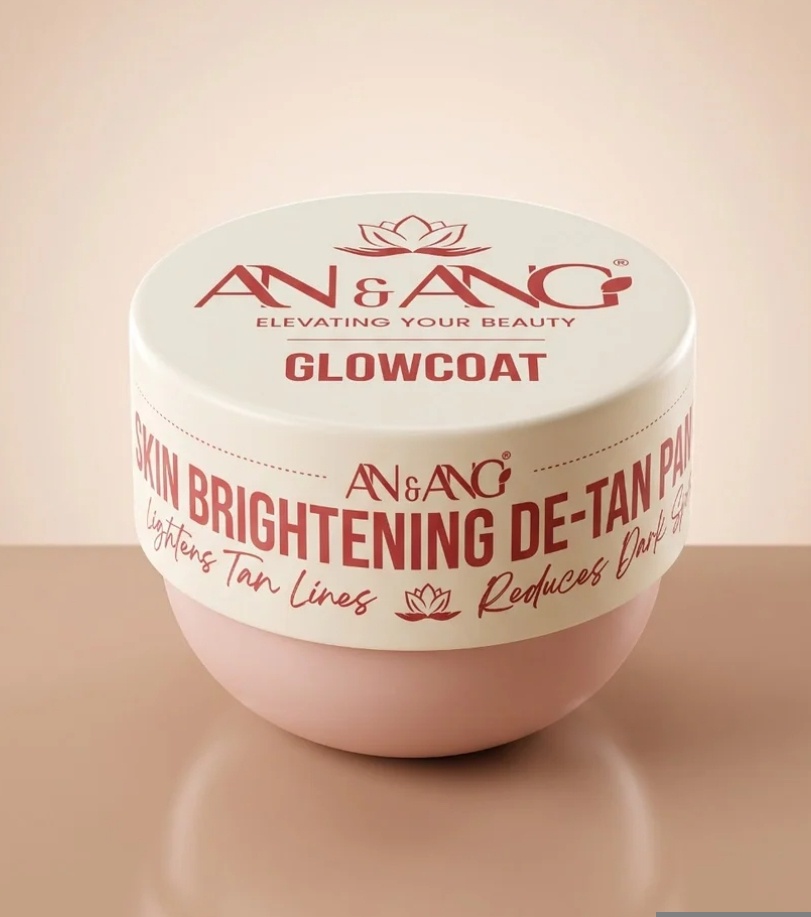
Glow Coat Skin Brightening De Tan Pack Saffron
Ingredients overview
Highlights
Skim through
An and ang Glow Coat Skin Brightening De Tan Pack SaffronIngredients explained
Good old water, aka H2O. The most common skincare ingredient of all. You can usually find it right in the very first spot of the ingredient list, meaning it’s the biggest thing out of all the stuff that makes up the product.
It’s mainly a solvent for ingredients that do not like to dissolve in oils but rather in water.
Once inside the skin, it hydrates, but not from the outside - putting pure water on the skin (hello long baths!) is drying.
One more thing: the water used in cosmetics is purified and deionized (it means that almost all of the mineral ions inside it is removed). Like this, the products can stay more stable over time.
A common multi-tasker fatty acid. It makes your skin feel nice and smooth (emollient), gives body to cream type products and helps to stabilize water and oil mixes (aka emulsions).
- A natural moisturizer that’s also in our skin
- A super common, safe, effective and cheap molecule used for more than 50 years
- Not only a simple moisturizer but knows much more: keeps the skin lipids between our skin cells in a healthy (liquid crystal) state, protects against irritation, helps to restore barrier
- Effective from as low as 3% with even more benefits for dry skin at higher concentrations up to 20-40%
- High-glycerin moisturizers are awesome for treating severely dry skin
A clear, colorless oil-like liquid that makes the skin feel smooth and nice (aka emollient) and it does so without it being greasy.
What's more, it can even reduce the heavy, greasy feel in products with high oil content. It's also fast-spreading meaning that it gives the formula a good, nice slip. It absorbs quickly into the skin and helps other ingredients to penetrate quicker and deeper.
Thanks to all this, it's one of the most commonly used emollients out there. There is just one little drawback: it has a high comedogenic index (5 out of 5...), so it might clog pores if you're prone to it.
Titanium Dioxide is one of the two members of the elite sunscreen group called physical sunscreens (or inorganic sunscreens if you’re a science geek and want to be precise).
Traditionally, UV-filters are categorized as either chemical or physical. The big difference is supposed to be that chemical agents absorb UV-light while physical agents reflect it like a bunch of mini umbrellas on top of the skin. While this categorization is easy and logical it turns out it's not true. A recent, 2016 study shows that inorganic sunscreens work mostly by absorption, just like chemical filters, and only a little bit by reflection (they do reflect the light in the visible spectrum, but mostly absorb in the UV spectrum).
Anyway, it doesn't matter if it reflects or absorbs, Titanium Dioxide is a pretty awesome sunscreen agent for two main reasons: it gives a nice broad spectrum coverage and it's highly stable. Its protection is very good between 290 - 350 nm (UVB and UVA II range), and less good at 350-400 nm (UVA I) range. Regular sized Titanium Dioxide also has a great safety profile, it's non-irritating and is pretty much free from any health concerns (like estrogenic effect worries with some chemical filters).
The disadvantage of Titanium Dioxide is that it's not cosmetically elegant, meaning it's a white, "unspreadable" mess. Sunscreens containing Titanium Dioxide are often hard to spread on the skin and they leave a disturbing whitish tint. The cosmetic industry is, of course, really trying to solve this problem and the best solution so far is using nanoparticles. The itsy-bitsy Nano-sized particles improve both spreadability and reduce the whitish tint a lot, but unfortunately, it also introduces new health concerns.
The main concern with nanoparticles is that they are so tiny that they are absorbed into the skin more than we want them (ideally sunscreen should remain on the surface of the skin). Once absorbed they might form unwanted complexes with proteins and they might promote the formation of evil free radicals. But do not panic, these are concerns under investigation. A 2009 review article about the safety of nanoparticles summarizes this, "to date, in-vivo and in-vitro studies have not demonstrated percutaneous penetration of nanosized particles in titanium dioxide and zinc oxide sunscreens". The English translation is, so far it looks like sunscreens with nanoparticles do stay on the surface of the skin where they should be.
All in all, Titanium Dioxide is a famous sunscreen agent and for good reason, it gives broad spectrum UV protection (best at UVB and UVA II), it's highly stable, and it has a good safety profile. It's definitely one of the best UV-filter agents we have today, especially in the US where new-generation Tinosorb filters are not (yet) approved.
A so-called fatty (the good, non-drying kind of) alcohol that does all kinds of things in a skincare product: it makes your skin feel smooth and nice (emollient), helps to thicken up products and also helps water and oil to blend (emulsifier). Can be derived from coconut or palm kernel oil.
An extremely common multitasker ingredient that gives your skin a nice soft feel (emollient) and gives body to creams and lotions. It also helps to stabilize oil-water mixes (emulsions), though it does not function as an emulsifier in itself. Its typical use level in most cream type formulas is 2-3%.
It’s a so-called fatty alcohol, a mix of cetyl and stearyl alcohol, other two emollient fatty alcohols. Though chemically speaking, it is alcohol (as in, it has an -OH group in its molecule), its properties are totally different from the properties of low molecular weight or drying alcohols such as denat. alcohol. Fatty alcohols have a long oil-soluble (and thus emollient) tail part that makes them absolutely non-drying and non-irritating and are totally ok for the skin.
It's a very alkaline stuff that helps to set the pH of the cosmetic formula to be just right. It's similar to the more often used sodium hydroxide and pretty much the same of what we wrote there applies here too.
The essential oil created by steam distilling the leaves of the Eucalyptus tree. It's a colorless, pale yellow oil with a camphoraceous aroma used traditionally in vapor rubs to treat coughs. Its name-giving main component is eucalyptol (also called 1,8-cineole, 80-91%) that has significant antibacterial and expectorant properties.
Among essential oils, Eucalyptus Globulus counts as rather non-sensitising with an EU sensitizer total of 5% (due to limonene). However, if your skin is super-sensitive or you are allergic to fragrances, it is still better to avoid it.
 We don't have description for this ingredient yet.
It’s pretty much the current IT-preservative. It’s safe and gentle, but even more importantly, it’s not a feared-by-everyone-mostly-without-scientific-reason paraben.
It’s not something new: it was introduced around 1950 and today it can be used up to 1% worldwide. It can be found in nature - in green tea - but the version used in cosmetics is synthetic.
Other than having a good safety profile and being quite gentle to the skin it has some other advantages too. It can be used in many types of formulations as it has great thermal stability (can be heated up to 85°C) and works on a wide range of pH levels (ph 3-10).
It’s often used together with ethylhexylglycerin as it nicely improves the preservative activity of phenoxyethanol.
If you have spotted ethylhexylglycerin on the ingredient list, most probably you will see there also the current IT-preservative, phenoxyethanol. They are good friends because ethylhexylglycerin can boost the effectiveness of phenoxyethanol (and other preservatives) and as an added bonus it feels nice on the skin too.
Also, it's an effective deodorant and a medium spreading emollient.
We don't have description for this ingredient yet.
It's a common little helper ingredient that helps water and oil to mix together. Also, it can help to increase the solubility of some other ingredients in the formula.
We don't have description for this ingredient yet.
We don't have description for this ingredient yet.
The essential oil coming from steam distillation of freshly harvested, flowering peppermint sprigs. Its major component is menthol that gives the oil its well-known refreshing and cooling properties. Peppermint oil is traditionally used as an inhalant for cold and coughs and there is also some clinical data validating its use against headaches by rubbing a peppermint oil cream on the forehead.
As for skincare, other than the nice grassy-minty smell and the refreshing sensations, we cannot write good things. It can be a skin irritant, so much so that it is a well-known counterirritant for muscle pains creating mild surface irritation to make things better in the deeper layers. But for everyday skincare, counterirritation is not something you wanna do, so we think that peppermint oil is better to avoid, especially if your skin is sensitive.
Super common little helper ingredient that helps products to remain nice and stable for a longer time. It does so by neutralizing the metal ions in the formula (that usually get into there from water) that would otherwise cause some not so nice changes.
It is typically used in tiny amounts, around 0.1% or less.
You may also want to take a look at...
| what‑it‑does | solvent |
| what‑it‑does | emollient | viscosity controlling |
| irritancy, com. | 0, 2-3 |
| what‑it‑does | skin-identical ingredient | moisturizer/humectant |
| irritancy, com. | 0, 0 |
| what‑it‑does | emollient | perfuming |
| irritancy, com. | 3, 3-5 |
| what‑it‑does | sunscreen | colorant |
| what‑it‑does | emollient | viscosity controlling |
| irritancy, com. | 2, 2 |
| what‑it‑does | emollient | viscosity controlling | emulsifying | surfactant/cleansing |
| irritancy, com. | 1, 2 |
| what‑it‑does | buffering |
| what‑it‑does | perfuming | antimicrobial/antibacterial |
| what‑it‑does | preservative |
| what‑it‑does | preservative |
| what‑it‑does | emollient | emulsifying | surfactant/cleansing |
| what‑it‑does | emulsifying | surfactant/cleansing |
| irritancy, com. | 0, 0 |
| what‑it‑does | perfuming |
| what‑it‑does | perfuming |
| what‑it‑does | chelating |