




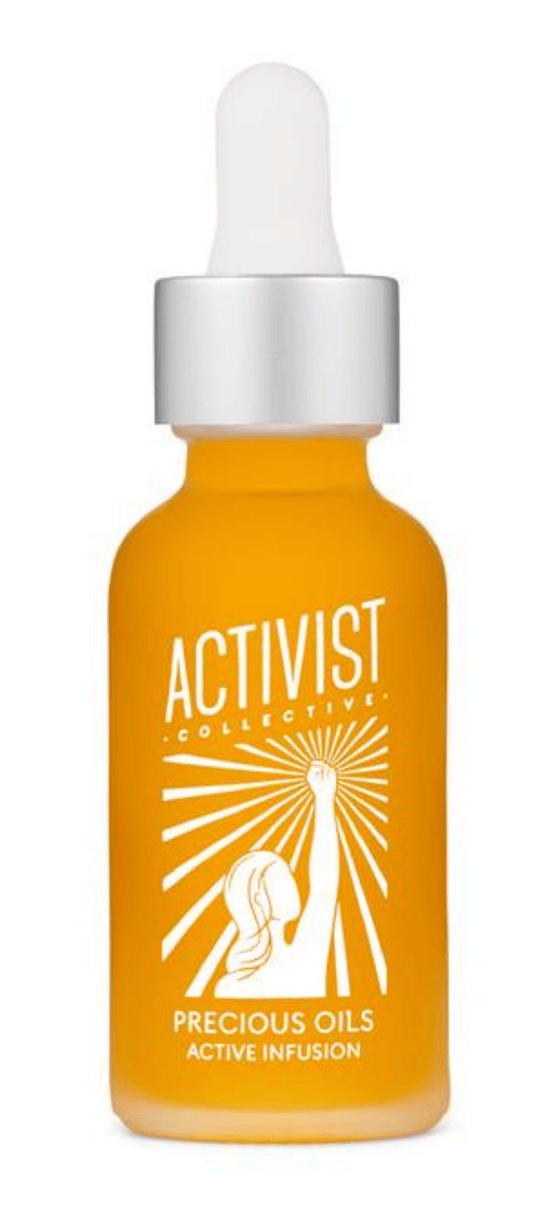
Precious Oils Active Infusion
Ingredients overview
Highlights
Key Ingredients
Other Ingredients
Skim through
| Ingredient name | what-it-does | irr., com. | ID-Rating |
|---|---|---|---|
| Vitis Vinifera (Grape) Seed Oil | antioxidant, emollient | goodie | |
| Persea Gratissima (Avocado) Oil | antioxidant, emollient | 0, 0-3 | goodie |
| Macadamia Ternifolia Seed Oil | emollient | goodie | |
| Simmondsia Chinensis (Jojoba) Seed Oil | emollient | 0, 0-2 | goodie |
| Calophyllum Inophyllum Seed (Tamanu) Oil | antioxidant, emollient, antimicrobial/antibacterial | goodie | |
| Morinda Citrifolia (Noni) Extract | |||
| Hippophae Rhamnoides (Sea Buckthorn) Fruit Extract | |||
| Punica Granatum Seed Oil | antioxidant, emollient | goodie | |
| Astaxanthin | antioxidant | goodie | |
| Lycopene | antioxidant | ||
| Lutein | |||
| Alpha Lipoic Acid | antioxidant | goodie | |
| Beta-Carotene | |||
| Bisabolol (Alpha) | soothing | goodie | |
| Ubiquinone (Coenzyme Q10) | antioxidant | goodie | |
| Cucumber | soothing, emollient | goodie | |
| Fragrance (Eu Safety Approved) | perfuming | icky | |
| Rosmarinus Officinalis (Rosemary) Leaf Extract | antioxidant, soothing, antimicrobial/antibacterial | goodie |
Activist Skincare Precious Oils Active InfusionIngredients explained
A goodie plant oil coming from the polyphenol-rich seeds of the grape. It's a light emollient oil that makes your skin feel smooth and nice and also contains a bunch of good-for-the-skin stuff. It's a great source of antioxidant polyphenols, barrier repair fatty acid linoleic acid (about 55-77%, while oleic acid is about 12-27%) and antioxidant, skin-protectant vitamin E.
The oil coming from the pulp of one of the most nutritious fruits in the world, the avocado. It's loaded with the nourishing and moisturizing fatty acid, oleic (70%) and contains some others including palmitic (10%) and linoleic acid (8%). It also contains a bunch of minerals and vitamins A, E and D.
Avocado oil has extraordinary skin penetration abilities and can nourish different skin layers. It's a very rich, highly moisturizing emollient oil that makes the skin smooth and nourished. Thanks to its vitamin E content it also has some antioxidant properties. As a high-oleic plant oil, it is recommended for dry skin.
The golden yellow oil coming from the Macadamia nut, a native Australian nut. Similar to other plant oils, it's loaded with emollient and nourishing fatty acids. It's a high oleic acid oil (50-67% oleic acid and only 0-5% linoleic acid) that makes it very emollient and ideal for dry skin types (and less ideal for acne-prone skin).
Its unique property is that it contains high amounts of a rare fatty acid called palmitoleic acid (12-25%) that give Macadamia oil a "cushiony" feel. It's also easily absorbed and makes the skin soft and supple.
Jojoba is a drought resistant evergreen shrub native to South-western North America. It's known and grown for jojoba oil, the golden yellow liquid coming from the seeds (about 50% of the weight of the seeds will be oil).
At first glance, it seems like your average emollient plant oil: it looks like an oil and it's nourishing and moisturizing to the skin but if we dig a bit deeper, it turns out that jojoba oil is really special and unique: technically - or rather chemically - it's not an oil but a wax ester (and calling it an oil is kind of sloppy).
So what the heck is a wax ester and why is that important anyway? Well, to understand what a wax ester is, you first have to know that oils are chemically triglycerides: one glycerin + three fatty acids attached to it. The fatty acids attached to the glycerin vary and thus we have many kinds of oils, but they are all triglycerides. Mother Nature created triglycerides to be easily hydrolyzed (be broken down to a glycerin + 3 fatty acid molecules) and oxidized (the fatty acid is broken down into small parts) - this happens basically when we eat fats or oils and our body generates energy from it.
Mother Nature also created wax esters but for a totally different purpose. Chemically, a wax ester is a fatty acid + a fatty alcohol, one long molecule. Wax esters are on the outer surface of several plant leaves to give them environmental protection. 25-30% of human sebum is also wax esters to give us people environmental protection.
So being a wax ester results in a couple of unique properties: First, jojoba oil is extremely stable. Like crazy stable. Even if you heat it to 370 C (698 F) for 96 hours, it does not budge. (Many plant oils tend to go off pretty quickly). If you have some pure jojoba oil at home, you should be fine using it for years.
Second, jojoba oil is the most similar to human sebum (both being wax esters), and the two are completely miscible. Acne.org has this not fully proven theory that thanks to this, jojoba might be able to "trick" the skin into thinking it has already produced enough sebum, so it might have "skin balancing" properties for oily skin.
Third, jojoba oil moisturizes the skin through a unique dual action: on the one hand, it mixes with sebum and forms a thin, non-greasy, semi-occlusive layer; on the other hand, it absorbs into the skin through pores and hair follicles then diffuses into the intercellular spaces of the outer layer of the skin to make it soft and supple.
On balance, the point is this: in contrast to real plant oils, wax esters were designed by Mother Nature to stay on the surface and form a protective, moisturizing barrier and jojoba oil being a wax ester is uniquely excellent at doing that.
A green-yellowish oil coming from cool places like Tahiti, Bora Bora, and the island of Polynesia. Similar to other more common plant oils, it's loaded with nourishing and moisturizing fatty acids (oleic acid: 30-55%, linoleic acid: 15-45%, palmitic acid: 5-20% and stearic acid: 5-25%).
The special thing about Tamanu oil, though, is that it contains the totally unique fatty acid called calophyllic acid that is suspected to give the oil its amazing healing and regenerative properties. The traditional uses of Tamanu oil range from using it for all kinds of rheumatism (inflammation in joints) to burns, wounds, skin rashes, and chapped lips and modern studies do confirm the wisdom of the old Polynesians. In fact, the wound healing properties of Tamanu oil is so strong that it produces visible improvements even for old (older than 1 year) scars during a 6-9 week period.
Other than that, according to manufacturer info, Calophyllum Inophyllum Oil also has significant SPF boosting and antioxidant properties. This latter one is probably due to its significant vitamin E content with delta-tocotrienol (236mg/kg) being the main form in the oil.
Overall, Tamanu seems to be an amazing oil for skin that is in need of some regeneration and protection.
 We don't have description for this ingredient yet.
The emollient plant oil coming from the seeds of Pomegranate. The red fruit has lots of seeds (100-200 per fruit), but 7 kg of them are needed for 1 kg of oil. Among the many similar plant oils, Pomegranate oil is a really unique one, as its main fatty acid (60%) is a rare one called punic acid, a so-called conjugated fatty acid with three double bonds. It also contains the common linoleic (2-10%) and oleic acids (3-12%), but only in small amounts.
Punic acid is thought to be a biologically active compound, a powerful anti-inflammatory, and antioxidant agent. The oil itself is also claimed to have strong antioxidant properties as well as having excellent nourishing and moisturizing abilities. On top of that, we also found a research that examined Pomegranate as a cosmeceutical source and it concluded that the seed oil can nicely promote the regeneration of the epidermis (the top layer of the skin).
An oil-loving, red-orange colored pigment that is becoming more and more well-known as a potent antioxidant.
If being an orange-colored pigment reminds you of beta-carotene from carrots, that is no coincidence: astaxanthin also belongs to the chemical group called carotenoids known for giving yellow, orange, or red color to plants. Our guy comes mostly from microalgae, a well-known and often used source is Haematococcus Pluvialis.
So Astaxanthin's main thing is being an antioxidant. You can take it as a supplement or slather it on your skin, it works both ways. A mouse skin study from 2012 found that a liposomal Astaxanthin formula prevented UV‐induced skin damage in multiple ways: UV-induced skin thickening, collagen reduction, and melanin formation were all hindered or prevented when the skin was pretreated with the Astaxanthin formula.
Another study from 2012 examined the cosmetic benefits of Astaxanthin and found that combining oral supplementation (6mg/day) and topical application for 8 weeks in 30 volunteers showed improvements in skin wrinkle (crow’s feet), age spot size (cheek), elasticity (crow’s feet), skin texture (cheek) and moisture content of the skin (cheek). If that would not be enough, a 2017 mouse study found our carotenoid molecule to be effective in speeding up wound healing.
Overall, Astaxanthin is an up and coming antioxidant nice to spot on any ingredient list.
Alpha-Lipoic Acid (ALA) is a great antioxidant that's also part of the body's natural antioxidant system. It's soluble both in water-rich and lipid-rich environments so it's versatile and can interact with many types of evil oxidants as well as other nice antioxidants.
ALA seems to be a great choice for topical use as studies show it can penetrate the skin rapidly where it's converted to DHLA (dihydrolipoic acid), an even more potent antioxidant molecule. A nicely designed (we mean double-blind, placebo-controlled) 12-week study from 2003 confirmed that 5% ALA cream can decrease skin roughness and improve general signs of photoaging statistically significantly. A slight catch, though, is that burning and warmth in the skin was quite a common side effect, especially in the first 4 weeks.
All in all, ALA is definitely a research-proven, great antioxidant but if your skin is sensitive higher concentrations might not be for you.
We don't have description for this ingredient yet.
It's one of the active parts of Chamomile that contains about 30% of bisabolol. It's a clear oily fluid that is used in skincare as a nice anti-inflammatory and soothing ingredient.
Thanks to Nivea, Q10 is a pretty well-known ingredient and the fame and Beiersdorf's (the parent company of Nivea) obsession with it are not for no reason. It's an antioxidant found naturally in human cells where it plays a big role in energy production.
In fact, it's so important for energy production that if taken as an oral supplement it has a caffeine-like effect and if taken at night you will probably not sleep very well (so you should take it in the morning). Q10 supplementation is not a bad idea: it not only gives you energy but research also shows that oral Q10 increases the Q10 level of the skin (of course, it decreases with age like pretty much every good thing in the skin) and may help to reduce wrinkles. If you are not for supplements, dietary sources include fish, spinach, and nuts.
As for skincare, Q10 comes in the form of a yellow, oil-soluble powder that's shown to absorb into the upper layer of the skin and act there like an awesome antioxidant. It not only has preventative effects but might also be able to reduce the depth of wrinkles, though 0.3% Q10 was used in the study that counts as really high (products containing that much should be very yellow!).
Cucumber is a nice, non-irritating plant extract that’s known for it’s soothing and emollient properties. It’s not something new to put it on our face: even Cleopatra used it to “preserve her skin”.
It’s commonly believed that cucumber is the answer to puffy eyes, but there is no research confirming this. What research does confirm is that it contains amino acids and organic acids that’s helpful for the skin’s acid mantle. There is also an enzyme (called shikimate dehydrigenase) in the pulp that’s shown to have anti-inflammatory properties.
Exactly what it sounds: nice smelling stuff put into cosmetic products so that the end product also smells nice. Fragrance in the US and parfum in the EU is a generic term on the ingredient list that is made up of 30 to 50 chemicals on average (but it can have as much as 200 components!).
If you are someone who likes to know what you put on your face then fragrance is not your best friend - there's no way to know what’s really in it.
Also, if your skin is sensitive, fragrance is again not your best friend. It’s the number one cause of contact allergy to cosmetics. It’s definitely a smart thing to avoid with sensitive skin (and fragrance of any type - natural is just as allergic as synthetic, if not worse!).
The extract coming from the lovely herb, rosemary. It contains lots of chemicals, including flavonoids, phenolic acids, and diterpenes. Its main active is rosmarinic acid, a potent antioxidant, and anti-inflammatory. It has also anti-bacterial, astringent and toning properties.
The leaves contain a small amount of essential oil (1-2%) with fragrant components, so if you are allergic to fragrance, it might be better to avoid it.
You may also want to take a look at...
| what‑it‑does | antioxidant | emollient |
| what‑it‑does | antioxidant | emollient |
| irritancy, com. | 0, 0-3 |
| what‑it‑does | emollient |
| what‑it‑does | emollient |
| irritancy, com. | 0, 0-2 |
| what‑it‑does | antioxidant | emollient | antimicrobial/antibacterial |
| what‑it‑does | antioxidant | emollient |
| what‑it‑does | antioxidant |
| what‑it‑does | antioxidant |
| what‑it‑does | antioxidant |
| what‑it‑does | soothing |
| what‑it‑does | antioxidant |
| what‑it‑does | soothing | emollient |
| what‑it‑does | perfuming |
| what‑it‑does | antioxidant | soothing | antimicrobial/antibacterial |