




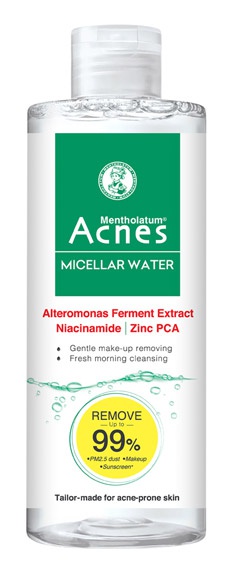
Micellar Water
Highlights
Key Ingredients
Other Ingredients
Skim through
| Ingredient name | what-it-does | irr., com. | ID-Rating |
|---|---|---|---|
| Water | solvent | ||
| Butylene Glycol | moisturizer/humectant, solvent | 0, 1 | |
| Pentylene Glycol | solvent, moisturizer/humectant | ||
| Poloxamer 184 | surfactant/cleansing, emulsifying | ||
| PEG- 8 Caprylic/Capric Glycerides | emulsifying | ||
| Alteromonas Ferment Extract | soothing | goodie | |
| Niacinamide | cell-communicating ingredient, skin brightening, anti-acne, moisturizer/humectant | superstar | |
| Zinc Pca | anti-acne, moisturizer/humectant | goodie | |
| Disodium Succinate | surfactant/cleansing | ||
| Succinic Acid | buffering | ||
| Disodium EDTA | chelating | ||
| Phenoxyethanol | preservative |
Acnes Micellar WaterIngredients explained
Good old water, aka H2O. The most common skincare ingredient of all. You can usually find it right in the very first spot of the ingredient list, meaning it’s the biggest thing out of all the stuff that makes up the product.
It’s mainly a solvent for ingredients that do not like to dissolve in oils but rather in water.
Once inside the skin, it hydrates, but not from the outside - putting pure water on the skin (hello long baths!) is drying.
One more thing: the water used in cosmetics is purified and deionized (it means that almost all of the mineral ions inside it is removed). Like this, the products can stay more stable over time.
Butylene glycol, or let’s just call it BG, is a multi-tasking colorless, syrupy liquid. It’s a great pick for creating a nice feeling product.
BG’s main job is usually to be a solvent for the other ingredients. Other tasks include helping the product to absorb faster and deeper into the skin (penetration enhancer), making the product spread nicely over the skin (slip agent), and attracting water (humectant) into the skin.
It’s an ingredient whose safety hasn’t been questioned so far by anyone (at least not that we know about). BG is approved by Ecocert and is also used enthusiastically in natural products. BTW, it’s also a food additive.
A multi-functional, silky feeling helper ingredient that can do quite many things. It's used as an emulsion stabilizer, solvent and a broad spectrum antimicrobial. According to manufacturer info, it's also a moisturizer and helps to make the product feel great on the skin. It works synergistically with preservatives and helps to improve water-resistance of sunscreens.
A synthetic polymer (a big molecule made of repeated units) that's used as a mild cleansing agent. It is also used in contact lens solutions and a regular on the ingredient lists of micellar cleansing waters.
Chemically speaking, it is an interesting molecule with an oil-loving part in the middle surrounded by two water-loving parts. The numbers in the molecule refer to the overall molecular size and the water-loving part in it (40%). Poloxamer 184 is almost half-half oil and water-soluble, likes to form micelles (molecules gathered into a ball form with oil-loving parts inside and water-loving parts outside) and is claimed to be an effective cleansing agent that is also mild on the skin and the eyes.
If you wanna know more about poloxamers, we have some more info at Poloxamer 407 >>
 We don't have description for this ingredient yet.
A so-called exopolysaccharide (high-molecular-weight polymers) secreted by a microorganism living in hydrothermal deep vents. The manufacturer claims that it soothes and reduces irritation to sensitive skin against chemical (such as drying acne treatments or strong chemical exfoliants), mechanical (such as micro-cuts after shaving) and UVB aggressors.
- A multi-functional skincare superstar with several proven benefits for the skin
- Great anti-aging, wrinkle smoothing ingredient used at 4-5% concentration
- Fades brown spots alone or in combination with amino sugar, acetyl glucosamine
- Increases ceramide synthesis that results in a stronger, healthier skin barrier and better skin hydration
- Can help to improve several skin conditions including acne, rosacea, and atopic dermatitis
If you have oily, acne-prone skin, Zinc PCA is one of the actives to put on your "TO TRY" list.
It's a synergistic association of two great things: Zinc and L-PCA. The Zinc part is there to help normalize sebum production and limit the proliferation of evil acne-causing bacteria. L-PCA stands for pyrrolidone carboxylic acid and it's a key molecule in the skin that helps with processes of hydration and energy (it's actually an NMF, a natural moisturizing factor).
L-PCA is not only there to hydrate the skin, but it also helps to increase the efficacy and bioavailability of zinc. An in-vivo (done on real people) test done by the manufacturer shows that Zinc PCA reduces sebum production statistically significantly after 28 days of application (1% was used in the test), and in-vitro (made in the lab) measurements show that Zinc PCA has strong anti-microbial activity against P. acnes (between 0.1-0.25%) and other bacterial strains.
If that would not be enough there is also a 2011 research paper saying that based on in-vitro (made in the lab, not on real people) findings Zinc PCA might be a promising anti-aging active that helps with the production of type I collagen (and we all know more collagen = firmer skin).
All in all, definitely a goodie for oily, acne-prone skin.
We don't have description for this ingredient yet.
Super common little helper ingredient that helps products to remain nice and stable for a longer time. It does so by neutralizing the metal ions in the formula (that usually get into there from water) that would otherwise cause some not so nice changes.
It is typically used in tiny amounts, around 0.1% or less.
It’s pretty much the current IT-preservative. It’s safe and gentle, but even more importantly, it’s not a feared-by-everyone-mostly-without-scientific-reason paraben.
It’s not something new: it was introduced around 1950 and today it can be used up to 1% worldwide. It can be found in nature - in green tea - but the version used in cosmetics is synthetic.
Other than having a good safety profile and being quite gentle to the skin it has some other advantages too. It can be used in many types of formulations as it has great thermal stability (can be heated up to 85°C) and works on a wide range of pH levels (ph 3-10).
It’s often used together with ethylhexylglycerin as it nicely improves the preservative activity of phenoxyethanol.
You may also want to take a look at...
| what‑it‑does | solvent |
| what‑it‑does | moisturizer/humectant | solvent |
| irritancy, com. | 0, 1 |
| what‑it‑does | solvent | moisturizer/humectant |
| what‑it‑does | surfactant/cleansing | emulsifying |
| what‑it‑does | emulsifying |
| what‑it‑does | soothing |
| what‑it‑does | cell-communicating ingredient | skin brightening | anti-acne | moisturizer/humectant |
| what‑it‑does | anti-acne | moisturizer/humectant |
| what‑it‑does | surfactant/cleansing |
| what‑it‑does | buffering |
| what‑it‑does | chelating |
| what‑it‑does | preservative |